
Bronx County Most Wanted Notices
The NYPD wanted page is the official image source for Bronx cases. It posts descriptions, videos, and Crime Stoppers links when public release helps an investigation. It is not a full warrant list for the borough. Nor is it a booking report or a tally of every arrest. The City Sheriff's Bronx office handles civil process and some warrant enforcement. It neither runs the wanted page nor keeps a county booking-photo system.
Photos there are not always booking shots. Some are surveillance stills, supplied portraits, or images pulled from social media. Everything stays hosted on NYPD's own service. Keep one limit in mind. A person can carry a warrant without ever appearing in public wanted material, because NYPD chooses what to post. Absence from the page means nothing. For status on a specific person, use the court and office-of-arrest route described below.
What Bronx Wanted Notices Show
Read the original NYPD notice itself. Fields vary case by case. You might find a name or alias, a case description, an incident location, a physical description, a photo, a video, contact details, or reward language. Docket numbers, arrest dates, and current court status are often missing. Fill no gaps with guesswork. Never match a notice to someone who merely shares a similar name.
| Notice element | How to treat it |
|---|---|
| Name or alias | An NYPD identification detail, not confirmation of a different record with the same name. |
| Photo or video | Official wanted material, which may not be a booking photograph. |
| Charge or case description | Use NYPD’s own words and treat it as an charge. |
| Tip direction | Use only the official reporting channel shown by NYPD. |
| Reward language | Read the notice terms; a reward is not automatic and can have conditions. |
| Publication date | Important context, but not proof that a notice remains active today. |
Note: For date, source, and status language, trust the original notice over any copied image that lacks an agency link.
Use Bronx Most Wanted Safely
Treat the official listing as a tool for awareness and lawful reporting. Confrontation is not part of the job. NYPD's wanted material often points to Crime Stoppers, a separate channel for passing information to law enforcement. If what you know could help an active public-safety response, use it. A listing gives no one the right to follow, question, or detain another person. Immediate danger belongs on 911. Never report it through a roster or a social-media post.
- Open the official NYPD wanted notice and confirm that the source is an NYPD page.
- Read the date, image description, charge language, and any stated tip instructions.
- Use Crime Stoppers or 911 as the circumstances require. Do not approach the person.
- For a person-specific custody or case question, use the official court, 311, DOC, or records route instead of speculating from the notice.
The Bronx custody and record search lays out the separate NYPD, 311, NYC DOC, FOIL, and court paths. A later DOC entry can show current custody after a court remand, though it is a different animal from an NYPD wanted notice.
Safety note: Never approach someone shown in a wanted notice; report tips through the official channel or call emergency services for an immediate threat.
Crime Stoppers and Bronx Tips
NYPD Crime Stoppers is the tip infrastructure behind selected wanted material. Options include anonymous phone, internet, text, and the CS-NYC app. Rewards may follow information leading to the arrest and indictment of a violent felon. The app also carries wanted flyers and social links. It will not search every Bronx booking. And it is not a public arrest-search app.
NYPD Crime Stoppers
The official channel for tips and wanted information
Use whatever contact method the Crime Stoppers page or related wanted notice currently lists.
Call 911 for any emergency or immediate safety threat.
Rewards and anonymity hinge on the program's current terms and the case at hand. Do not post a person's private details or repeat an unverified name match. The agency that issued the notice decides when a correction, update, or removal is warranted.
Check a Bronx Warrant
No official public roster confirms every Bronx criminal or bench warrant. NYC 311 sends criminal-warrant questions to Criminal Court information and the office of arrest. Its arrest-warrant instructions list Bronx Criminal Court warrant information at 215 East 161st Street, Bronx, NY 10451, (718) 618-2460. A citywide Criminal Court line sits at (646) 386-4900. Those offices can route a specific court matter properly.
One more thing 311 makes clear. Warrants do not expire with the passage of time. Resolution comes from an appearance before the issuing judge or from death, not avoidance. Anyone who suspects a warrant applies should call the court or an attorney before acting. The Office of the Sheriff, City of New York, handles a different category of civil-process and warrant-service work. Its Bronx office is not a general criminal-warrant lookup desk.
| Warrant context | Official route | What it is not |
|---|---|---|
| Criminal or bench warrant question | Bronx Criminal Court information and office of arrest | A searchable public photo list |
| Selected public wanted case | NYPD wanted page and Crime Stoppers | Proof of a current court disposition |
| Civil-process or specified Sheriff matter | NYC Sheriff arrest-warrant information | A Bronx jail, booking, or NYPD warrant roster |
- Confirm whether the concern is a criminal-court matter or a civil-process matter.
- Contact the court information line or office of arrest for criminal-warrant routing.
- Seek legal advice from a qualified attorney when personal representation is needed.
- Follow the issuing court’s instructions. Do not try to evade, conceal, or privately resolve a warrant.
The NYC 311 warrant-information page shows the official court-routing source for this Bronx process.
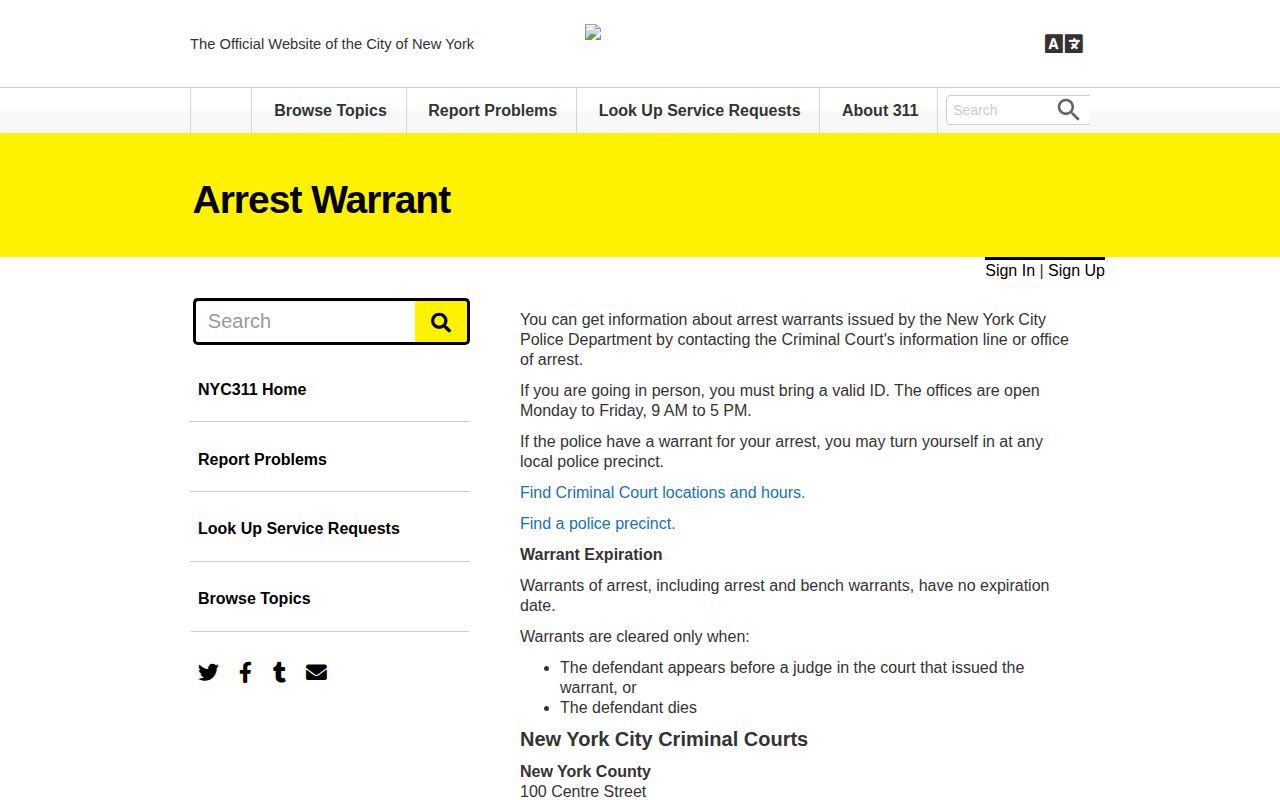
Rely on the live 311 instructions and the court's current contact details. The source routes warrant questions; it is neither a public warrant list nor a finding about any particular person.
Bronx Wanted Images and Status
NYPD wanted images serve one purpose: they ask the public for help. That is where their usefulness ends. A picture on a wanted notice will not show a booking date, tell you where someone is held, or reveal how a case turned out. In the Bronx this matters more than elsewhere, since the sheriff here runs no booking gallery of its own. Answers live in separate places. NYPD's wanted page, its newsroom, the 311 custody route, NYC DOC, and the courts each cover a different slice of the story, so matching the question to the right office saves time.
Notices also shift with the investigation behind them. A posting can be edited or pulled entirely once the case moves. If you find a report about someone in a notice, save the official URL and its date, then look at the court record for anything newer. Reusing the image elsewhere is a bad idea. Posting it in a fresh gallery, or treating it as proof of a warrant or of danger, goes beyond what NYPD's live notice actually says.
After a Bronx Wanted Notice
Once someone on a notice is captured or arraigned, the picture changes fast. Release, remand to NYC DOC, a transfer, revised charges, or a different court outcome are all possible. The notice alone tells you none of it. The DOC lookup answers one narrow question: who is in custody right now. For everything after that, court records and a Certificate of Disposition are the right places to look. NYPD newsroom items shift too as investigations develop.
Each source proves only its own fact. A wanted notice shows that NYPD published it on a given date. A DOC result shows custody status at the moment you pulled it. A court document shows a court event or outcome. Blend them into one label and you end up treating an old notice as still current, which misleads everyone who reads it.